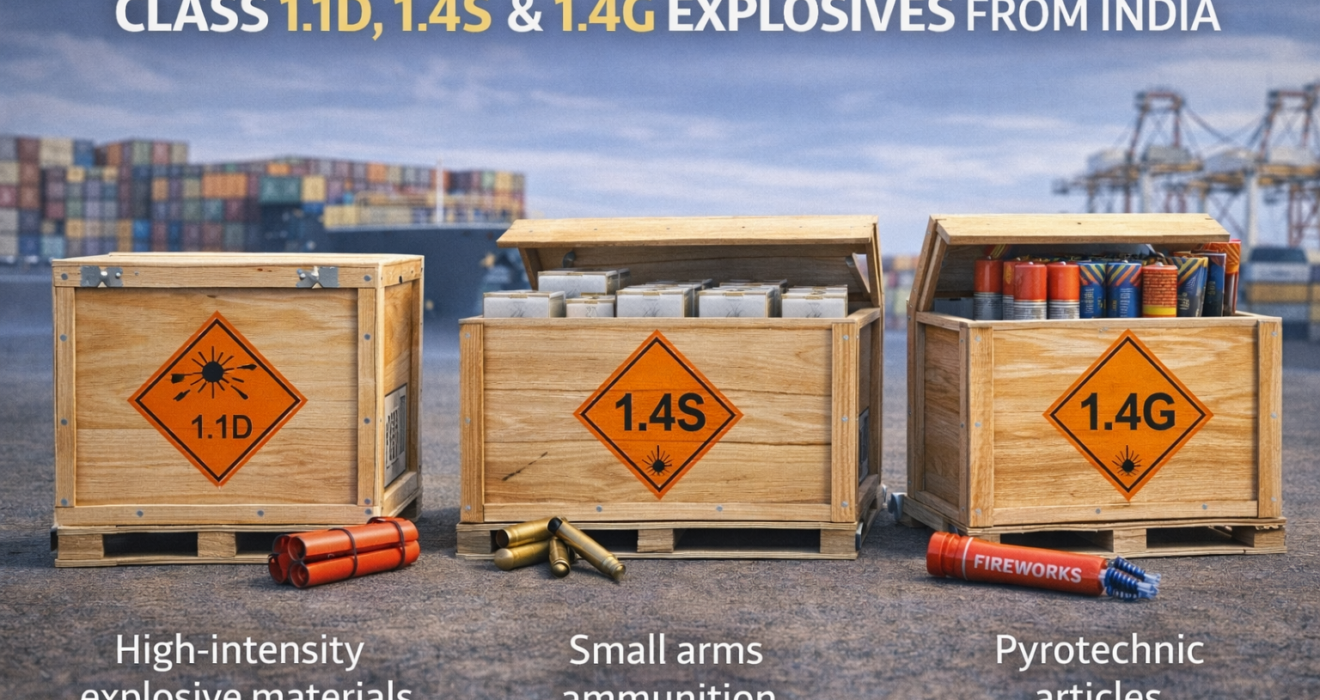
How to Ship Class 1.1D, 1.4S & 1.4G Explosives from India
Shipping Explosives Is Not Like Shipping Chemicals
When it comes to Class 1 cargo, you are dealing with materials that present explosion hazards during transport.
Mistakes don’t cause delays.
They cause vessel rejection, severe penalties, and regulatory action.
That’s why Class 1 explosives shipping from India requires strict compliance with international maritime law.
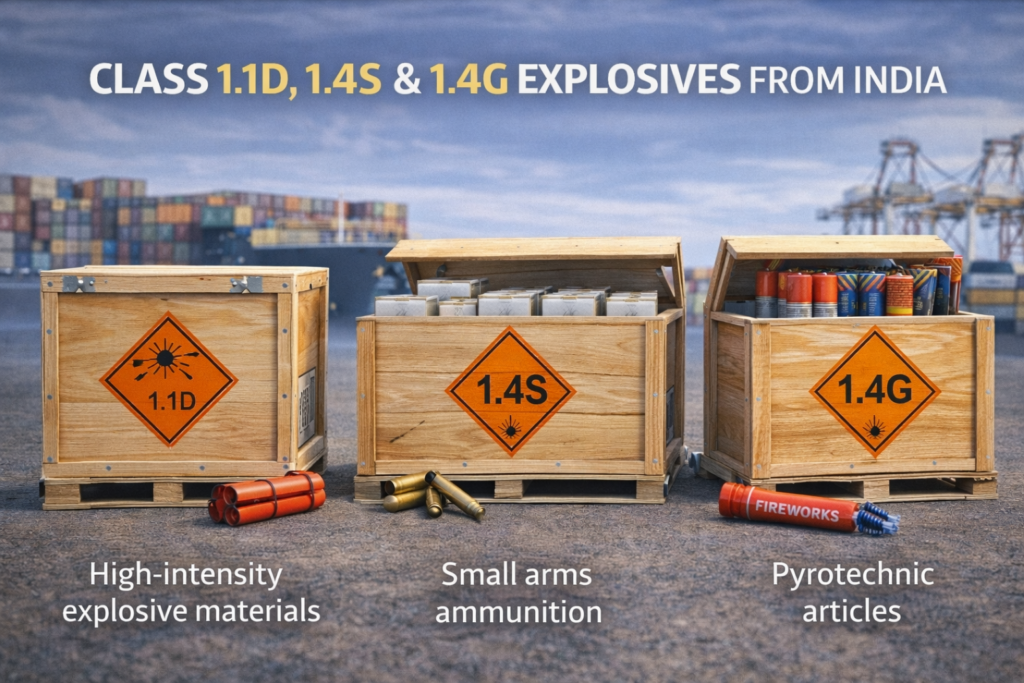
Let’s break down the specific divisions: 1.1D, 1.4S, and 1.4G.
Understanding Class 1 Explosives Under IMDG
Explosives are regulated globally under the IMDG Code issued by the International Maritime Organization.
Class 1 is divided into six divisions based on explosion risk.
We’ll focus on three common export categories.
Class 1.1D – Mass Explosion Hazard
What It Means
Division 1.1 includes substances that present a mass explosion hazard.
If one unit explodes, the entire shipment can detonate simultaneously.
The compatibility group “D” typically includes:
-
Secondary detonating explosives
-
Certain blasting explosives
-
High-intensity industrial explosive materials
Risk Level
This is among the highest-risk DG categories in ocean freight.
Therefore:
-
Vessel acceptance is limited
-
Stowage restrictions are strict
-
Port approvals are mandatory
Key Compliance Requirements
For 1.1D shipping from India:
-
Advance carrier approval
-
Competent authority certification
-
DG declaration (DGD)
-
Proper UN number assignment
-
Special segregation onboard vessel
Indian exports must also align with regulations from the Directorate General of Shipping India.
Class 1.4G – Minor Explosion Hazard (Pyrotechnics)
What It Means
Division 1.4 includes explosives that present limited hazard.
Compatibility group “G” commonly includes:
-
Fireworks
-
Pyrotechnic articles
-
Signal flares
If an incident occurs, it is usually confined to the package.
Risk Level
Lower than 1.1D, but still highly regulated.
Compliance Considerations
-
Approved packaging (UN certified)
-
IMDG labeling and placarding
-
Controlled stowage on vessel
-
Accurate declaration
Fireworks shipments often move during peak seasons, so early booking is critical.
Class 1.4S – Very Limited Hazard
What It Means
Division 1.4S includes explosive articles that present no significant blast hazard outside the package.
Examples may include:
-
Certain small arms ammunition
-
Limited-quantity explosive articles
Risk Level
This is the lowest risk within Class 1 divisions.
However, it is still regulated as explosive cargo.
Shipping Conditions
Although carrier acceptance is easier than 1.1D, documentation accuracy remains critical.
Improper classification can result in rejection.
What Makes Explosives Shipping Complex from India?
Exporting explosives involves:
-
Multiple government approvals
-
Police and licensing clearances
-
Port authority permissions
-
Carrier vetting
-
Strict stowage planning
Additionally, vessel operators follow IMDG safety standards set by the International Maritime Organization.
Not all shipping lines accept Class 1 cargo.
Cost Factors for Class 1 Explosives Shipping
Explosives shipping is significantly more expensive than any standard cargo or DG Class.
Cost components include:
-
High-risk DG surcharge
-
Special handling charges
-
Limited carrier availability
-
Dedicated stowage planning
-
Additional port supervision
For large consignments, exporters may consider FCL ocean freight solutions to maintain container integrity and reduce handling.
For smaller or specialized cargo, coordination with hazardous cargo shipping services becomes essential.
Common Mistakes That Cause Shipment Rejection
Most rejections occur due to:
-
Incorrect compatibility group declaration
-
Incomplete DGD documentation
-
Improper packaging certification
-
Last-minute booking without carrier pre-approval
As a result, shipments may face heavy demurrage and storage penalties.
Why Explosives Require Expert Handling
Class 1 cargo involves:
✔ Regulatory scrutiny
✔ Limited vessel options
✔ Strict segregation rules
✔ International compliance checks
Therefore, exporters must work with experienced DG logistics providers who understand IMDG compliance end-to-end.
Planning to ship Class 1.1D, 1.4S, or 1.4G explosives from India?
Ensure full compliance and avoid costly shipment rejection.
Contact Aipex Worldwide for expert Class 1 explosives shipping support.